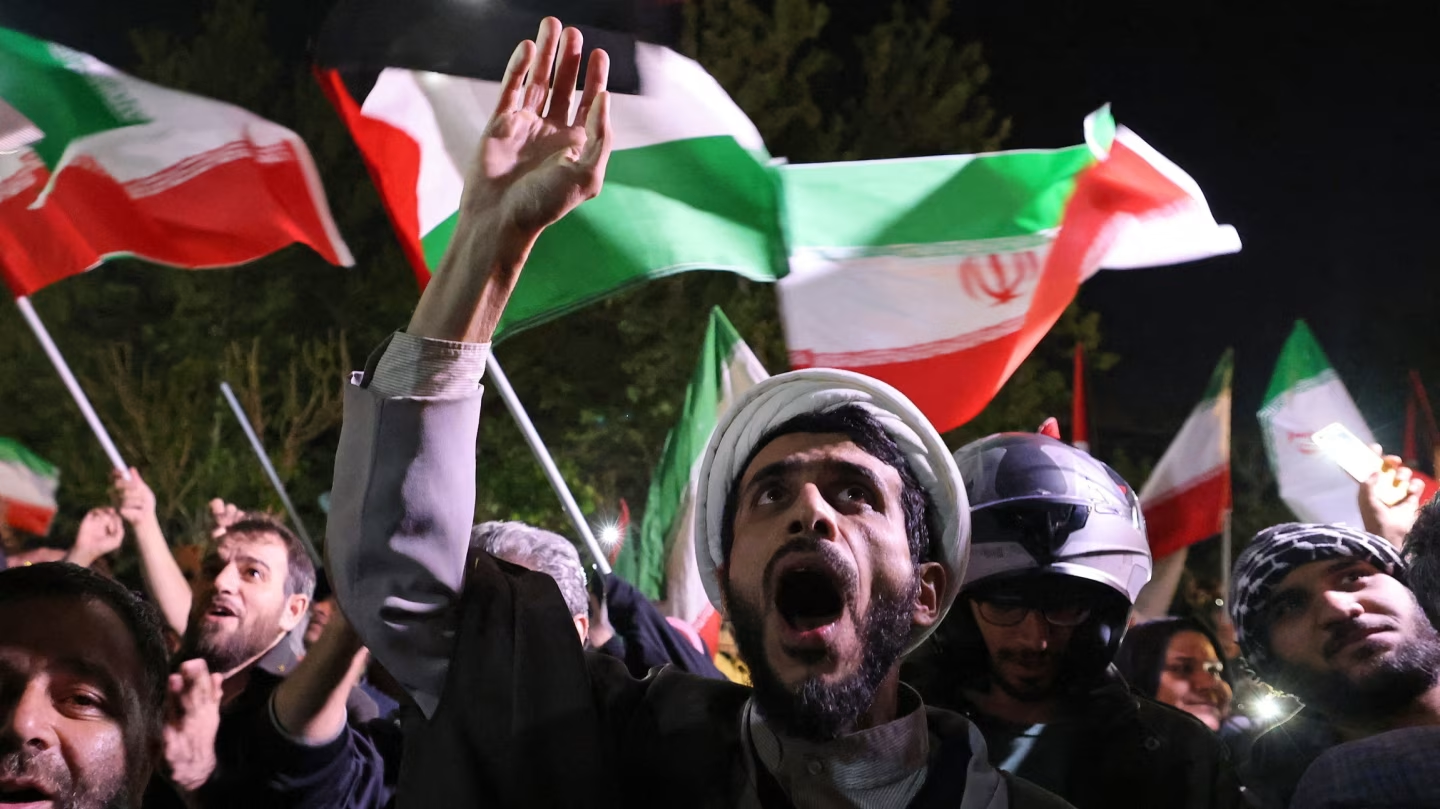
JERUSALEM/TEHRAN – The Middle East finds itself on a precipice, as mounting evidence suggests the recent clashes between Israel and Iran were but a prelude to a more formidable and potentially devastating confrontation. Intelligence assessments and strategic maneuvers by both regional powers and their international allies indicate a profound shift in the geopolitical landscape, raising serious concerns about an imminent eruption of hostilities.
Iran’s Accelerated Military Reconstitution and Russian Strategic Lifeline
In a rapid and significant display of resilience, Iran has reportedly achieved a swift restoration of its air defense infrastructure. This includes not only the domestically developed Bavar 373 systems but also advanced S-300 batteries, which suffered damage in the prior skirmish. According to detailed accounts from Reuters, this accelerated recovery has been critically bolstered by a strategic lifeline from Russia. Multiple IL-76 transport aircraft are believed to have delivered crucial S-300 air defense components and associated materiel, enabling Iran to swiftly compensate for losses. The impetus behind this urgent rearmament is clear: during the preceding 12-day conflict, Israeli aircraft were able to operate with relative impunity over Iranian airspace, successfully targeting key missile platforms. Mahmoud Mousavi, Deputy Commander of Operations in the Iranian Army, has publicly affirmed the successful and complete restoration of these vital national air defense assets, signaling Iran’s readiness to deter future incursions. This renewed defensive posture, buttressed by Russian technical and logistical support, is set to significantly complicate any future Israeli aerial operations and could alter the tactical calculus of the region.
Israel’s Iron Resolve: Bolstering Layered Defense Systems
In parallel, Israel is demonstrating an unwavering commitment to fortifying its multi-layered air defense architecture. The nation has placed substantial orders for its advanced Arrow air defense missiles, a critical component designed specifically to intercept long-range ballistic missiles. The Arrow system, particularly the Arrow 2 and Arrow 3 variants, is engineered to engage threats at high altitudes, including in space, providing a defense against a spectrum of ballistic missile threats, from Scud derivatives to more advanced Iranian missile programs. This significant procurement underscores Israel’s determination to maintain a robust deterrent posture and protect its population and strategic assets from potential Iranian missile barrages. The Arrow system complements Israel’s other defense tiers, such as the Iron Dome for short-range rockets and David’s Sling for medium- to long-range threats, forming a comprehensive shield against aerial threats.
The Enduring Nuclear Question: A Catalyst for War
Perhaps the most potent flashpoint remains Iran’s nuclear program, which intelligence reports suggest was largely untouched during the recent hostilities. Democratic strategist Adam Smith has publicly refuted earlier claims by President Donald Trump that Iran’s nuclear infrastructure had been dismantled. This assessment is supported by Israeli intelligence, which confirmed that highly enriched uranium in Iranian facilities remained intact. This unverified but persistent capability raises grave international concerns. Should Iran decide to reactivate its nuclear program in full, potentially pursuing weaponization, it could trigger another, far more devastating conflict in the region, with global ramifications. The international community, particularly European powers, are keenly observing Iran’s steps, with the looming threat of “snapback” sanctions from the UN Security Council if Iran does not return to full compliance and transparency regarding its nuclear activities.
Shifting Alliances: Russia’s Gambit and China’s Ascendancy
Amidst these rising tensions, the geopolitical landscape is being reshaped by the evolving roles of major global powers. Russian President Vladimir Putin is reportedly pushing for a novel nuclear agreement that would preclude Iran from enriching uranium on its own soil, instead proposing that Russia become the sole supplier of enriched uranium. This audacious proposal is seen by many as a strategic maneuver by Putin to reassert Russia’s diplomatic centrality and influence any future nuclear deal between Iran and European nations, further cementing Moscow’s regional leverage.
Concurrently, a significant recalibration is underway in Tehran’s foreign policy. Newsweek has highlighted Iran’s growing inclination to strengthen its alliance with China, signaling a deliberate move away from its traditional reliance on Russia. This strategic pivot is largely a consequence of Russia’s ongoing entanglement in Ukraine, which has limited Moscow’s capacity to offer substantial military and economic support to Iran in the event of a renewed conflict. China, increasingly focused on its expansive Belt and Road Initiative and maintaining stability in the Middle East for its economic interests, is now viewed by Tehran as a more reliable and potentially potent military ally. This burgeoning Sino-Iranian partnership is contingent on Iran aligning its regional policies with China’s broader objectives, including fostering improved relations with its Middle Eastern neighbors, a move that could fundamentally alter regional power dynamics.
The Aftermath of the 12-Day War: Lessons and Strategic Miscalculations
A detailed article in Foreign Policy by Raphael Cohen, director of the Rand Corporation, offered a sobering assessment of the recent 12-day conflict. Cohen revealed that Israel sustained significant losses, enduring 550 missile launches with an interception rate of 85-87%, notably lower than its projected 90%. The report suggested that Israel’s decision to cease hostilities was influenced by mounting casualties and the ultimate failure to completely neutralize Iran’s nuclear program. This outcome has led to critical self-reflection within Israeli strategic circles.
The long-standing U.S. and Israeli strategy, often compared to past approaches with figures like Saddam Hussein and Bashar al-Assad, has historically aimed to weaken adversary regimes through targeted military strikes on strategic assets, with the implicit hope of fostering internal collapse. However, current analyses suggest this approach may prove ineffective against Iran. The Islamic Republic has demonstrated remarkable resilience, largely due to a perceived lack of significant internal opposition capable of overthrowing the regime, coupled with consistent economic and diplomatic support from global powers like China and Russia. This resilience complicates any strategy centered on regime change and suggests that a purely military solution may not achieve the desired long-term outcomes, compelling a re-evaluation of Western policy in the region.
As diplomatic efforts falter and military preparations intensify on both sides, the specter of a full-scale conflict looms larger over the Middle East. The interplay of regional rivalries and shifting global alliances creates an extraordinarily complex and precarious situation, leaving the international community on edge for what could be the next, far more destructive chapter in the long-standing Israel-Iran confrontation.